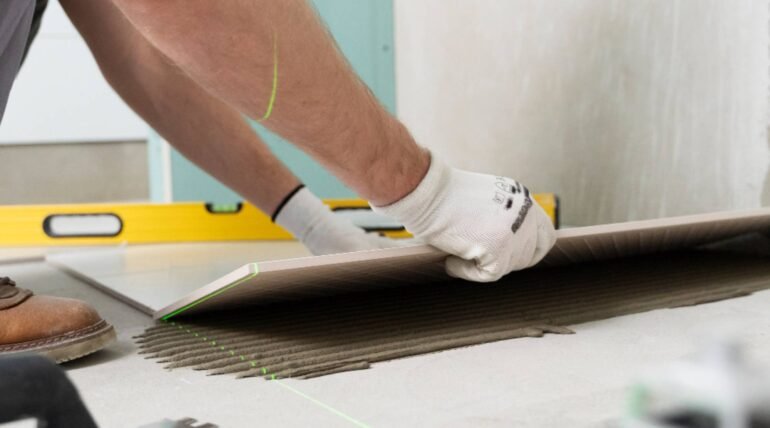
Large-format tile fixing looks incredible when it’s done well. But it’s also one of those jobs where tiny oversights snowball into seriously costly problems. Cracked floors, uneven walls, tiles that lift after a few months. These issues almost always trace back to the same handful of mistakes.
The better news is that each one of them is completely preventable.
1. Skipping Surface Prep
The substrate needs to be flat, dry, and free of contamination before a single tile goes down. Dust, grease, or minor dips in the surface create weak points that show up later, usually at the worst time.
Large-format tiles cover more area than standard tiles, so even slight unevenness becomes visible across the finished surface. Running a long spirit level across the substrate before starting catches these issues early, especially on high-rise façade projects where rework gets expensive fast.
2. Using the Wrong Adhesive
Standard cement-based adhesives weren’t designed to carry the weight and surface area of oversized tiles. On exterior or elevated surfaces, using the wrong product doesn’t just risk a failed installation. It creates a genuine safety concern.
A polymer-modified adhesive or full-bed mortar rated for large-format tile fixing handles the job properly. On mechanical fixing projects, the adhesive works alongside the anchoring system, so compatibility between both needs verification before anything gets applied.
3. Leaving Air Pockets Under the Tile
A lot of installers spread adhesive only on the floor and call it done. That approach creates air pockets underneath the tile, and over time, those hollow spots lead to cracking, drumming sounds, and eventual tile failure.
Back-buttering closes those gaps. The coverage target for large-format tile fixing sits at 95% or above. On mechanically fixed façade tiles, insufficient coverage puts uneven stress on anchors and clips, which compromises the structural integrity of the entire cladding system.
4. Underestimating Lippage
Lippage is the noticeable height difference between two adjacent tiles. It’s one of the most frequent complaints in large-format tile fixing, and on commercial projects, it can also create trip hazards that fall outside safety compliance requirements.
A few things that genuinely help:
- Running a levelling system throughout the entire installation.
- Checking flatness every few tiles rather than assuming everything’s sitting right.
- Confirming that the rail or T-profile substructure is correctly aligned before tiles go in.
5. Forgetting Expansion Joints
Tiles move. Temperature changes, humidity shifts, and building settlement all cause tiles to expand and contract. Without expansion joints, that movement has nowhere to go, and tiles start pushing against each other until something gives.
Expansion joints are required every 4 to 6 meters across the field and at every wall-to-floor junction. On façade cladding systems, this isn’t just best practice. It’s a structural safety requirement, and skipping it is one of the most expensive mistakes to fix after the fact.
6. Skipping Mechanical Support on External Facade
Adhesive-only on exterior walls, high-rise façades, and surfaces in high-wind or seismic zones, relying on adhesive alone is a serious risk.
Mechanical fixing system along with Adhesive is used with large-format tiles to prevent lippage and ensure proper leveling between adjacent tiles.
It maintains consistent spacing and alignment while the adhesive sets, improving the overall finish and durability.
7. Starting Without a Layout Plan
Starting installation without dry-laying the tiles first almost guarantees awkward cuts near entrances or unbalanced patterns. On mechanically fixed façade systems, poor planning also creates anchor misalignment, which forces improvisation that weakens the fixing grid.
Mapping anchor points before drilling and spending time on a dry layout catches those problems before the real work begins.
If your next project involves large-format tile fixing and you want it done right the first time, the Fix and Fine Gulf team is ready to help.
Frequently Asked Questions
What qualifies as a large-format tile?
Any tile where at least one side measures 60 cm or longer falls into the large-format category. Tiles used in façade cladding often exceed 120 cm on one side.
When does large-format tile fixing require a mechanical system?
Exterior surfaces, high-rise façades, and areas with high wind loads or seismic activity almost always require mechanical fixing. Adhesive-only systems don’t meet the structural and safety requirements for these applications.
How long before grouting can start?
Most adhesives need a minimum of 24 hours. Some products designed for large-format tile fixing require up to 48 hours. The product label and project specifications both have a say here.
Can large-format tiles work on vertical surfaces?
Absolutely, but the adhesive needs a non-slip rating for walls. On exterior vertical surfaces, a mechanical fixing system alongside the adhesive provides the retention and safety compliance the installation demands.
We deliver high-quality tile application services with a commitment to precision and excellence. Through dedication and attention to detail, we ensure every project is completed to the highest standards.
