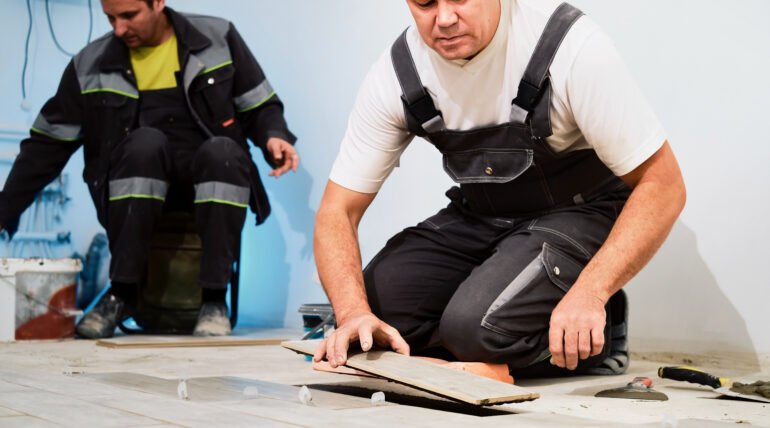
A façade panel falling from the 20th floor isn’t a hypothetical. It’s happened in the UAE, and it’s exactly why regulators tightened compliance rules for high-rise cladding work. That risk is why façade tile contractors matter so much on large projects. This isn’t a job for whoever’s cheapest or fastest. Get it wrong, and you’re looking at safety hazards, costly rework, and a building that ages badly within a few years. We’ve spent years fixing tile on facades across Dubai, Abu Dhabi, and Sharjah, and we’ve seen what separates a façade that lasts 25 years from one that starts failing in five. Let’s walk through why professional execution isn’t optional for developers and main contractors managing large-scale work.
What Do Façade Tile Contractors Actually Do?
Façade tile contractors handle the design coordination, mechanical fixing, and installation of tile or stone cladding on a building’s exterior. Their work covers structural assessment, anchoring system selection, alignment precision, and compliance with local building codes. On large projects, this role extends into project management, coordinating with architects, main contractors, and safety inspectors throughout construction. Professional façade cladding contractors don’t just stick tiles to a wall. They calculate wind load, thermal movement, and weight distribution before a single panel goes up. Skipping these steps is how buildings end up with cracked joints or, worse, falling panels.
We at Fix and Fine Technical Services Contracting LLC manage this entire process for our clients, from initial site assessment through final inspection.
Why Does Façade Safety Depend on Professional Installation?
Façade safety depends on professional installation because incorrect mechanical fixing is the leading cause of tile failure on high-rise buildings. According to the Dubai Municipality building safety guidelines, exterior cladding must meet specific anchoring and load-bearing standards before occupancy approval is granted. Untrained crews often skip these calculations entirely. Wind load in Dubai regularly exceeds 150 km/h during storm season. A façade tile that isn’t anchored to withstand that pressure becomes a genuine hazard, not just a maintenance headache.
Structural Stability and Mechanical Fixing Standards
Structural stability starts with choosing the right tile anchoring systems for the building’s height and exposure level. Mechanical fixing uses clips, rails, or adhesive-mechanical combinations depending on tile weight and substrate material. Heavier stone cladding needs different anchoring than lightweight large format tile installation. Getting this wrong doesn’t show up immediately. Problems surface two or three years later, when thermal expansion and contraction start loosening improperly fixed panels.
Tile Alignment and Precision Workmanship Requirements
Alignment issues are the most visible sign of amateur façade work. Crooked joints, inconsistent gaps, and mismatched tile patterns are hard to miss from street level, and harder to fix once the scaffolding comes down. Precision workmanship requires laser-guided alignment tools and experienced installers who understand how substrate irregularities affect the finished surface. We use these methods on every project, checking alignment at multiple stages rather than just at the end.
Professional Contractors vs Unskilled Labor: What’s the Difference?
| Factor | Professional Façade Contractors | Unskilled Labor Crews |
| Structural calculations | Done before installation | Often skipped entirely |
| Anchoring systems | Matched to tile weight and height | Generic, one-size approach |
| Compliance documentation | Provided for inspections | Rarely available |
| Alignment precision | Checked at multiple stages | Checked only at completion |
| Project timeline management | Coordinated with main contractor | Minimal coordination |
| Long-term durability | 25+ years with proper upkeep | Failures within 3-5 years |
Developers who’ve dealt with rework costs after hiring the cheaper option usually don’t make that mistake twice.
How Do Large-Scale Construction Projects Benefit from Specialists?
Large-scale construction projects lean on façade tile contractors because complex builds need coordinated scheduling, quality control, and compliance tracking across a bunch of different trades at once. A high-rise project can involve hundreds of workers across different specialties, and façade work has to line up with scaffolding schedules, weather windows, and inspection deadlines all at the same time. Tile cladding specialists bring their own project management systems to the table, tracking progress, documenting compliance, and catching issues early before they turn into expensive problems. Main contractors juggling tight deadlines need that kind of structure to steer clear of costly delays.
Construction Compliance and Documentation Standards
Construction compliance is more than just paperwork. It’s what protects developers from liability and makes sure the building actually passes final inspection without dragging things out. Professional contractors document every stage of the process, from material certification through to anchoring test results. We put together full documentation packages for every façade project, so developers and consultants have exactly what they need for regulatory sign-off, without having to chase us down for records later.
Key Takeaways: Hiring Façade Tile Contractors
- Professional installation is what stands between a safe building and structural failure or safety hazards
- Mechanical fixing needs to match the tile’s weight, the building’s height, and its wind exposure
- Precise alignment matters for looks, but it matters even more for how long the façade lasts
- Compliance documentation is what protects developers from liability down the road
- Experienced contractors know how to manage timelines across every phase of a project
- Large format tile installation calls for specialized handling given the size of the panels
Checklist for Choosing a Façade Cladding Contractor
- Ask to see references from previous high-rise or commercial projects
- Make sure they can provide structural and compliance documentation
- Check whether they’ve actually worked with your specific tile or stone material before
- Ask how they approach wind load and anchoring calculations
- Confirm they have the project management capacity for your building’s timeline
- Ask about warranty terms, both for materials and workmanship
We at Fix and Fine Technical Services Contracting LLC check every box on this list, and we’re happy to walk developers through our documentation before any work begins. We handle façade tile cladding and large format tile installation for commercial and residential projects across the UAE. If you’ve got a large-scale build coming up and want a team that gets both compliance and craftsmanship right from the start, reach out and we’ll take you through our process.
Frequently Asked Questions
How do façade tile contractors handle weather delays on large projects?
Contractors build weather contingency right into the project schedule, especially with UAE’s summer heat and the occasional storm to deal with. Work usually pauses once wind speeds go past safe installation limits, and experienced teams just shuffle tasks around to keep the overall timeline intact without cutting corners on quality.
What certifications should a façade cladding contractor have in the UAE?
Reputable contractors carry trade licenses from the relevant UAE authorities and stick to Dubai Municipality or equivalent emirate-level building codes. Look out for contractors who can hand over material certifications, anchoring test reports, and proof of compliance with local structural and fire safety rules before any work starts.
Can façade tile contractors work on occupied buildings during renovation?
Yes, experienced contractors handle façade renovation on occupied buildings all the time, using scaffolding systems and safety barriers to keep disruption to a minimum. Work gets timed to cut down on noise during business hours wherever possible, and safety perimeters keep residents or occupants safe from falling debris the whole way through.
How long does façade tile installation take on a high-rise building?
Timelines shift depending on the building’s height and how much façade area needs covering, but for a typical high-rise, full exterior coverage usually takes 3 to 6 months. Things like tile size, weather, and scaffolding availability all play into the final schedule and when the project actually wraps up.
What happens if a façade tile installation fails inspection?
Failed inspections usually come down to anchoring problems, alignment issues, or paperwork that’s missing, and contractors have to fix these before the building can get occupancy approval. Good contractors act on inspection feedback fast, since any delay here throws off the whole project timeline and can rack up extra costs for the developer.
We deliver high-quality tile application services with a commitment to precision and excellence. Through dedication and attention to detail, we ensure every project is completed to the highest standards.
