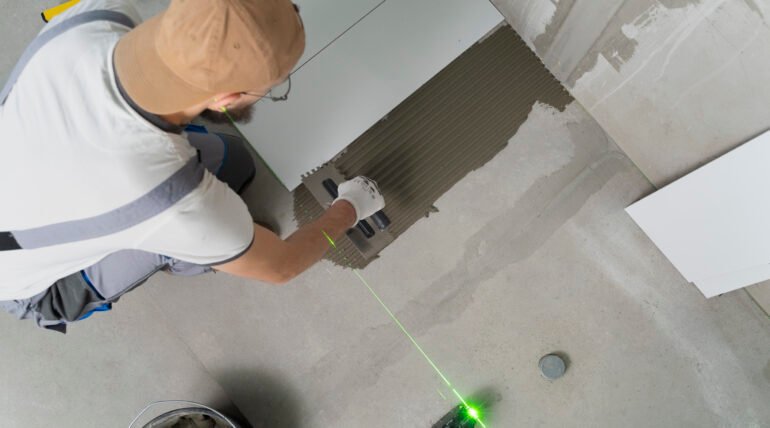
When developers plan a commercial building, every decision around the exterior matters. The façade faces the weather, carries the brand image of the business, and needs to stay safe for decades. That is why more and more developers across the UAE are choosing mechanical tile fixing systems over traditional adhesive-based methods.
Fix and Fine Gulf specializes in mechanical tile fixing systems for façade tile cladding on commercial, hospitality, and mixed-use developments. We work with developers, architects, and contractors from project planning all the way through to installation.
Mechanical vs. Adhesive: What Is the Real Difference?
Traditional tile installation relies on adhesive or mortar to bond tiles to a surface. This works well for interior floors and walls. But on a commercial building façade, it creates problems over time.
Heat causes materials to expand. Cold causes them to contract. Adhesive bonds weaken when such changes happen repeatedly. In the UAE, where summer temperatures regularly exceed 45°C, this thermal movement is constant.
Mechanical tile fixing systems use anchors, brackets, rails, and clips to hold tiles in place through physical support. The tiles do not rely on adhesive alone. Each panel is independently secured to a structural sub-frame.
This means the façade stays stable even as temperatures swing through the day and across seasons.
Why Mechanical Tile Fixing Systems Deliver Better Safety on Commercial Projects
Safety is the top concern on any commercial building project. A failing tile on a high-rise can cause serious injury and major liability.
Mechanical tile fixing systems distribute the load of each tile panel across multiple anchor points. If one anchor experiences stress, the others carry the load. This redundancy makes the system far more reliable than a single adhesive bond.
For large-format tiles, this mechanical support becomes even more important. Large tiles carry more weight and create more surface area for wind pressure to act on. Mechanical fixing handles both.
UAE building regulations require façade systems on high-rise and commercial structures to meet strict wind load and safety standards. Mechanical fixing systems are designed and tested to meet these requirements.
Built for the UAE Climate
The UAE climate tests every material on a building’s exterior. Heat, UV radiation, humidity near the coast, and sandstorms all work against façade systems that are not built for these conditions.
A ventilated façade system using mechanical fixing creates an air cavity between the tiles and the building wall. This cavity ventilates naturally, which reduces heat transfer into the building and lowers energy costs.
Fix and Fine Gulf uses stainless steel and coated aluminum components in all our mechanical tile fixing systems. These materials resist corrosion and hold their structural properties even after years of UAE weather exposure.
Easier Maintenance Means Lower Lifetime Costs
Developers think beyond the build date. A façade that is hard to maintain costs more over time.
With mechanical fixing, individual tile panels can be accessed and replaced without disturbing the panels around them. This is especially useful for buildings that stay occupied during maintenance, like hotels, office towers, and retail developments.
Façade tile cladding installed with mechanical systems also holds its appearance longer. Tiles stay flush and aligned because each one is independently supported. There is no risk of adhesive failure causing panels to shift or bow outward.
What Types of Commercial Projects Benefit Most?
Mechanical tile fixing suits almost any commercial project, but it adds the most value in the following:
- High-rise office towers and residential towers
- Hotels and hospitality properties
- Shopping centers and retail parks
- Hospitals and institutional buildings
- Mixed-use developments in high-footfall areas
These projects have large façade areas, strict safety requirements, and long operational lifespans. Mechanical tile fixing systems match all three needs.
Conclusion: A Smart Investment for Commercial Developers
Choosing mechanical tile fixing systems is not just about the installation day. It is about how the building performs, how safe it stays, and how easy it is to maintain for the next 30 to 40 years.
Fix and Fine Gulf brings the experience, materials, and technical skill to deliver façade tile cladding that meets the highest standards in the UAE. If you are planning a commercial project, reach out to our team and let us help you get it right from the start.
Frequently Asked Question
Q1: Are mechanical tile fixing systems more expensive than adhesive methods upfront?
Yes, the initial cost is usually higher than adhesive installation. However, mechanical systems cost less over the building’s lifetime because they are easier to repair.
Q2: Can mechanical fixing systems accommodate different tile materials beyond porcelain?
Yes, mechanical fixing systems can be used with porcelain, natural stone, composite panels, and fiber cement boards. The type of tile, its thickness, and its weight determine which anchor and bracket design to use.
Q3: Do mechanical tile fixing systems require special maintenance schedules?
They do get something out of inspections that happen every two to three years. Technicians look for signs of wear or corrosion on the anchors, clips, and sub-frame. Mechanical systems are easier to check and fix before any panels become a safety risk than adhesive systems, which can fail without making any noise.
We deliver high-quality tile application services with a commitment to precision and excellence. Through dedication and attention to detail, we ensure every project is completed to the highest standards.
